REVIEW · HELSINKI
Helsinki: Architectural Highlights Guided Walking Tour
Book on GetYourGuide →Operated by Helsinki Dreamdays Walking Tour · Bookable on GetYourGuide
Helsinki’s buildings tell a whole story. This 3-hour walking tour in the compact city center connects the dots between architecture and everyday Finnish life, guided by a Sociology PhD student in English, with an option to tailor the focus ahead of time.
I love that it’s not just exterior photos. You get a real mix of styles—from classic landmarks to functionalism and modern design—plus time at major public buildings like the National Library and Oodi, guided by people who can explain the why. One watch-out: you’ll cover 5 to 6 km on foot, in rain or shine, and it isn’t suitable for wheelchair users.
In This Review
- Why this Helsinki walk works
- Meet at Fazer Kluuvikatu: an easy start
- Senate Square and Helsinki Cathedral: the city’s formal face
- National Library of Finland: a stop built for ideas
- Jugend cafés, Kappeli, and Esplanadi’s wide streets
- Monuments and book culture: Runeberg, Academic Bookstore, and Rautatalo
- Helsinki Central Station and Kansalaistori: life around the routes
- Oodi Central Library and the wave-shaped public space
- Amos Rex and Kamppi Chapel: art and quiet inside modern Helsinki
- Pohjola Insurance Building and ending back at Fazer Kluuvikatu
- Price and value: what you get for $56
- Customization: how to tailor the styles you want to see
- Who this small-group tour suits best
- Should you book this Helsinki architecture walk?
- FAQ
- How long is the Helsinki Architectural Highlights guided walking tour?
- Where do I meet the guide?
- How many people are in the group?
- Is the guide available in English?
- Does the tour run in bad weather?
- How much walking is involved?
- What is included in the price?
- Can I customize what styles or periods we focus on?
- What is the cancellation policy?
Why this Helsinki walk works
- Small group (up to 6), so you can ask questions and keep a good pace
- Inside stops, including major public buildings, so you see more than street façades
- Lots of architectural styles in one route, from neoclassical to contemporary
- Helsinki as a World Design Capital (2012) and UNESCO City of Design comes through in the sights
- You can pre-customize the time spent on specific periods or styles
- Aalto, Saarinen, Engel, Sonck, Siren, and more are woven into what you notice on the walk
Meet at Fazer Kluuvikatu: an easy start

I like meeting at a place that feels familiar and practical. You’ll start in front of Fazer Café on Kluuvikatu, which keeps the start clean—no hunting, no complicated directions.
From there, the tour moves at a steady walking speed with short guided moments where it matters. It’s the kind of setup that works well if Helsinki is new to you and you want a structured way to get your bearings fast.
You can also read our reviews of more walking tours in Helsinki



Senate Square and Helsinki Cathedral: the city’s formal face

You’ll begin with Senate Square for about 15 minutes. It’s a classic “start here” kind of spot, the sort of space that helps you understand Helsinki’s scale and how the buildings line up across the street.
Next comes Helsinki Cathedral. You’ll pass by it briefly, so this isn’t a slow, in-depth cathedral day. Still, that quick orientation moment helps because the rest of the route keeps shifting styles, and you need a reference point.
National Library of Finland: a stop built for ideas

The National Library of Finland gets real time on the tour (around 15 minutes). This is where the architecture stops being background and starts acting like a cultural statement.
I appreciate tours that treat libraries as more than quiet buildings. Here, you get a chance to notice how design supports public life, study, and civic identity—especially useful in a city that puts so much thought into everyday spaces.
Jugend cafés, Kappeli, and Esplanadi’s wide streets
You’ll then hit the Robert’s Coffee Jugend stop (about 10 minutes). Jugend usually means Art Nouveau energy—curves, ornament, and details that are easy to miss unless someone points them out.
Kappeli follows for a shorter visit. The point isn’t long sightseeing; it’s learning how Helsinki mixes formal architecture with spaces people actually use. Then you move to Esplanadi for a walk-and-look stretch (about 10 minutes), which is a great way to absorb the city’s rhythm between landmarks.
This part of the tour is also where Helsinki’s “design city” identity starts to feel tangible. You’re in the compact center, surrounded by buildings that reflect the city’s care with form and function—and you can see how that design shows up on the street, not just in museums.
Monuments and book culture: Runeberg, Academic Bookstore, and Rautatalo
A short stop at Johan Ludvig Runeberg’s memorial (about 5 minutes) adds a human thread to the architectural walk. Even without going super long here, it helps you connect the city’s built environment to the people and cultural moments Finns choose to remember.
Then you’ll visit the Academic Bookstore for around 10 minutes. I like this sort of stop because it shows how culture lives inside everyday institutions, not only in big-name monuments.
Rautatalo comes next (about 5 minutes). This is a quick one, but it’s useful for learning what to look for—especially façade details and the way older styles can still feel meaningful in modern Helsinki.
One practical note: some office-style interiors may be harder to access depending on the day. If you can choose, a weekday often gives you smoother access to places that are run like workplaces, not tourist sets.
You can also read our reviews of more guided tours in Helsinki






Helsinki Central Station and Kansalaistori: life around the routes

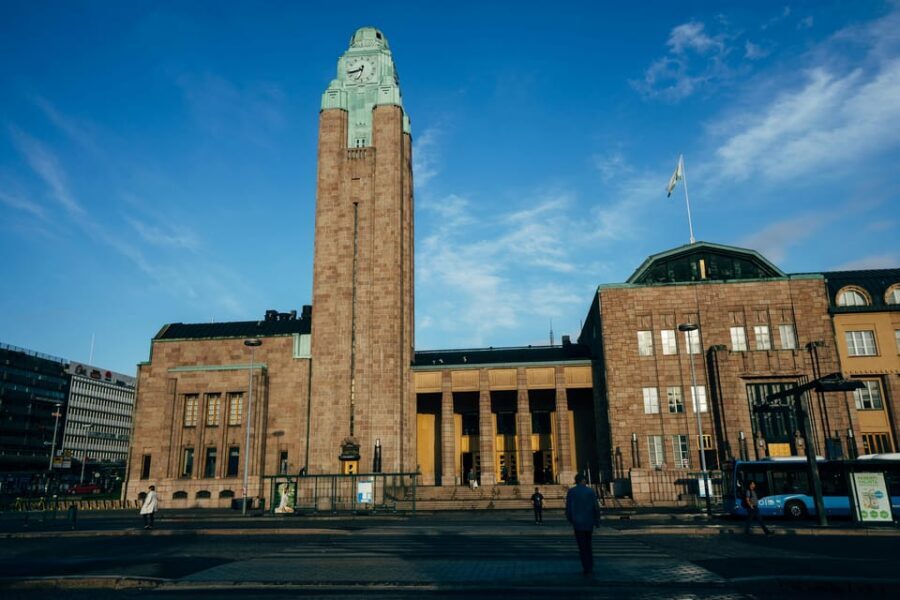
Helsinki Central Station gets about 10 minutes. This stop is important because it’s not “historic décor”—it’s a working hub where architecture has to handle real traffic, real schedules, and real movement.
After that, you’ll visit Fazer Café at Sanomatalo. It’s a fun contrast: a brand you recognize, inside a building that represents Helsinki’s modern design story. It also gives you a warmer pause without breaking the walk’s momentum.
Then you’ll go to Kansalaistori (about 15 minutes). I like this timing because it gives you a chance to watch how people use public space in the city center. You’re not just learning styles—you’re seeing the city’s social rhythm.
Oodi Central Library and the wave-shaped public space

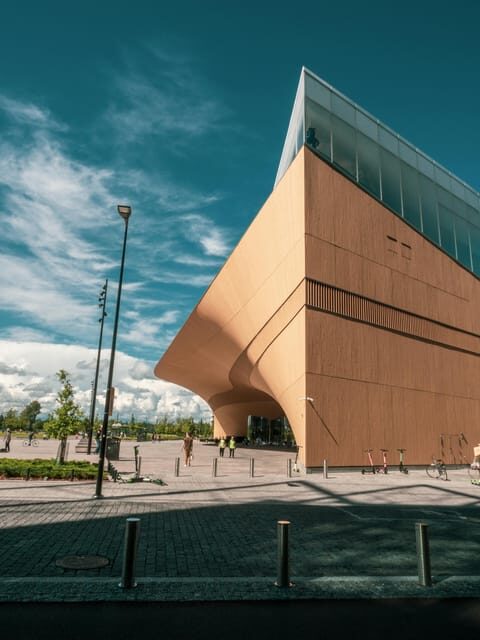
Oodi Central Library is one of the stops most worth getting excited about (about 20 minutes). It’s also where the tour’s design focus lands hardest.
Many people describe Oodi as a wave-shaped community space, and I get why. It feels like a building designed for gathering, noise, and creativity—not only quiet reading. That matters, because architecture isn’t just a visual style in Helsinki; it’s a way the city shapes how people meet and spend time.
This is also a great moment to slow down in your head. Earlier stops threw many styles at you. Here you start to understand the pattern: Helsinki uses architecture to build public confidence in everyday life.
Amos Rex and Kamppi Chapel: art and quiet inside modern Helsinki

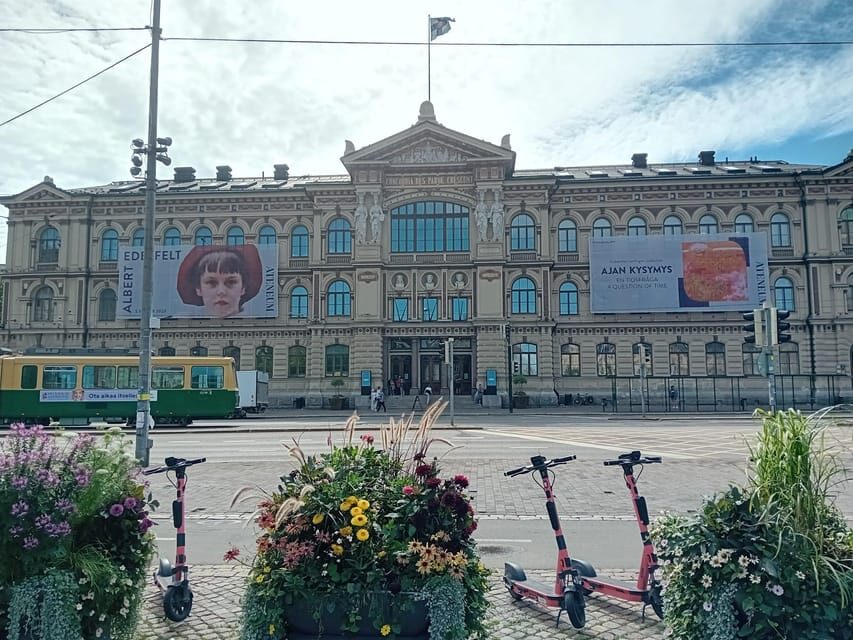
Amos Rex comes next with a short guided moment (about 5 minutes). Even with limited time, it’s a strong signal that the tour isn’t stuck in past centuries. It’s showing you contemporary Helsinki as a design-forward city.
Then you pass Kamppi Chapel (about 5 minutes). It’s brief, but it provides balance: one minute you’re in an art-focused environment, and the next you’re reminded that the city also values calm spaces in the middle of busy routes.
I find the short “pass by” style stops useful here. They keep the walking tour efficient, while still giving you a sense of where modern Helsinki places its priorities—art, reflection, and public life.
Pohjola Insurance Building and ending back at Fazer Kluuvikatu
You’ll finish with a visit to the Pohjola Insurance building (around 5 minutes) before returning to Fazer Café Kluuvikatu. It’s another quick stop, but it helps reinforce the tour’s overall goal: show how different eras left their mark on a compact city.
By the time you’re back at the starting café, you’ll likely realize the tour didn’t just list buildings. It taught you how Helsinki’s architectural language shifts across time—neoclassical forms, Gothic Revival touches, Renaissance Revival influences, Art Nouveau details, Nordic classicism, functionalism, and then modern and contemporary design.
And that’s the real value. After this, you won’t just recognize landmarks—you’ll know what to look for.
Price and value: what you get for $56
$56 for a 3-hour small-group guided walk is reasonable for what you’re getting. You’re paying for more than route coverage—you’re paying for (1) an English-speaking local guide, (2) a group size capped at 6, and (3) time at multiple major buildings where you can actually look closer than you would on your own.
If you plan to spend Helsinki learning on foot anyway, the guide cost starts to feel like the smartest part of your budget. The route is designed to be compact (5 to 6 km), and you get a built-in structure for architectural learning, not random wandering.
You should still expect that this isn’t a “sit inside every building forever” kind of day. Some stops are short by design, so your best bet is to tell the guide what you want to focus on before you go.
Customization: how to tailor the styles you want to see
This tour lets you customize the experience in advance. That’s a big deal, because Helsinki’s architectural range can feel like a blur if you don’t have a lens.
If you care most about older styles, ask the guide to spend extra time on the neoclassical and Revival-era buildings. If you’re into the modern story, put emphasis on functionalism, modernism, and contemporary design stops like Oodi and the art museum stop.
Also, because the guide is a Sociology PhD student, you’ll likely get more than style names. The explanations tend to connect buildings to how society works—how public spaces invite behavior, and how design supports daily routines.
Who this small-group tour suits best
I’d send you on this if you want a fast, high-quality introduction to central Helsinki architecture without doing the homework yourself. It’s also ideal if you like discussion and asking questions, since the group is limited to 6.
It works especially well for first-time visitors who have limited time, since the route covers major stops in about three hours. If you already love architecture, you’ll still benefit because you’ll get guided “what to notice” prompts instead of just hopping between famous buildings.
Avoid it if you can’t manage 5 to 6 km of walking in rain or shine. Also, it isn’t suitable for wheelchair users, so don’t count on an alternate route.
Should you book this Helsinki architecture walk?
Yes, if you want a guided hit of Helsinki’s architectural styles with real stops inside major public buildings. The price makes sense for a small group, and the structure means you’ll leave with both visual memory and a sharper understanding of what the city is trying to do through design.
Book it particularly if Oodi and the city’s design reputation matter to you, or if you want to connect architecture to Finnish culture and social life. If your schedule is tight, this is one of the simplest ways to make a short Helsinki afternoon feel meaningful and specific.
FAQ
How long is the Helsinki Architectural Highlights guided walking tour?
The tour lasts 3 hours.
Where do I meet the guide?
Meet in front of Fazer Café Kluuvikatu, and the guide waits there.
How many people are in the group?
The tour is a small group with a maximum of 6 participants.
Is the guide available in English?
Yes, the live tour guide speaks English.
Does the tour run in bad weather?
Yes, the tour takes place rain or shine.
How much walking is involved?
Plan for about 5 to 6 kilometers of walking.
What is included in the price?
Included are the walking tour and the local guide.
Can I customize what styles or periods we focus on?
Yes. You can let the provider know in advance if you have specific periods or architectural styles you want to see.
What is the cancellation policy?
You can cancel up to 24 hours in advance for a full refund.