REVIEW · HELSINKI
Helsinki Walking Tour With a Sociologist
Book on Viator →Operated by Helsinki Dreamdays Walking Tour · Bookable on Viator
Helsinki’s social rules show up in landmarks. This 3-hour walk uses a sociologist’s lens, so you don’t just look at buildings—you learn why they matter for everyday life in Finland. You get a smart mix of politics, faith, public spaces, and design, with plenty of time to ask questions.
I like two things most. First, the small group size keeps it human, so you can actually talk with the guide (often mentioned as Zana Balikci, among others). Second, the library focus turns Helsinki’s love of reading and civic space into a real storyline, not a quick photo stop.
One consideration: a couple of major sights may require separate entry tickets, and some places have weekend closures (the National Library is closed Saturday and Sunday, and the Old Market Hall is closed Sundays). Plan your day around that if your trip lands on a weekend.
In This Review
- Key points I’d circle before you go
- A sociologist-led Helsinki walk that explains how people live
- Meeting at Kluuvikatu 3 and finishing at Oodi Library
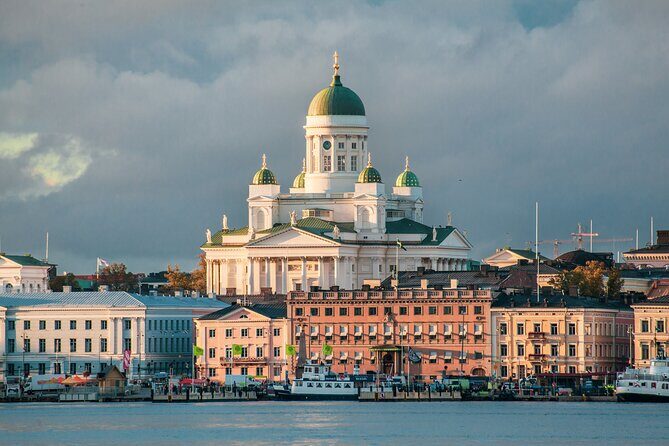
- Senate Square: where Helsinki starts telling its modern story
- Helsinki Cathedral inside: faith as a cultural lens
- National Library of Finland: why a library is civic architecture
- Presidential Palace and Parliament: democracy you can point at
- Uspenski Cathedral: Russian Orthodox architecture in Helsinki
- Kauppatori and Old Market Hall: shopping as local ritual
- Esplanadi and city rhythm: a boulevard for all seasons
- Lasipalatsi Glass Palace and Finnish music in architecture
- Central Railway Station to Oodi: Helsinki’s monuments and everyday pride
- Value and logistics: what you’re really paying for
- Who this tour fits best
- Should you book this sociologist-led Helsinki walking tour?
- FAQ
- How long is the Helsinki Walking Tour with a Sociologist?
- What is the meeting point and the ending point?
- Is the tour in English?
- How many people are in the group?
- What’s included in the price?
- Is food or transportation included?
- Are admissions included for all stops?
- Are any stops closed on weekends?
- Can I get a full refund if I cancel?
Key points I’d circle before you go
- Small group (max 6) keeps the pace easy and questions welcome
- Library stops like Oodi change how you think about public space
- Democracy on the streets gets explained at Presidential Palace and Parliament areas
- Markets and public life at Kauppatori and Old Market Hall show how Helsinki eats and shops
- A mix of Lutheran and Russian Orthodox architecture helps explain Finland’s religious mindset
- Most major stops are free to enter, with a couple likely paid separately
A sociologist-led Helsinki walk that explains how people live

Helsinki can feel orderly at first glance. But once you start connecting the dots—where people gather, how institutions work, and what public buildings are for—the city becomes more understandable. That’s the point of this tour: it treats the city like a social system, not a checklist.
You’ll keep moving through central Helsinki on foot, but the emphasis stays on meaning. The guide frames sights through everyday Finnish life: civic trust, community spaces, and the way different cultures show up in architecture.
And yes, the walking route includes the big-picture icons you’d expect. The twist is how they’re interpreted, especially around government and public libraries.
You can also read our reviews of more walking tours in Helsinki



Meeting at Kluuvikatu 3 and finishing at Oodi Library

The tour starts at Kluuvikatu 3 and ends at Oodi (Helsinki Central Library), Töölönlahdenkatu 4. That end point is a nice payoff because Oodi is not just a library building—it’s a public “hang-out” space where you can see how Finland uses common areas for everyone.
You’ll spend roughly 3 hours walking and stopping. It’s a format that works well for first-time visitors because you get orientation fast, without getting stuck on one museum at a time.
A mobile ticket is included, and the tour runs in English. It’s also set up for a small group—maximum 6 travelers—so it doesn’t feel crowded or rushed.
Senate Square: where Helsinki starts telling its modern story
Your first stop is Senate Square, the hub where modern Helsinki history is anchored. The guide focuses on the three main buildings around the square, and how their presence connects to how the city grew into what it is today.
This is a smart starting point because it sets the tone. You’re not only learning what to look at—you’re learning how to read a city square: who built it, why that mattered, and what it signals about power and culture.
If you like architecture, you’ll probably enjoy this part most. Even if you don’t, you’ll get a quick framework that makes later stops easier to understand.
Helsinki Cathedral inside: faith as a cultural lens
Next comes Helsinki Cathedral. You don’t just stand outside; you enter together and the guide connects the building to Finland’s religious mindset.
A practical note: admission is not included here. So if you’re trying to keep everything single-ticket, you’ll want to expect either separate payment or a ticket purchase before/at entry. (The tour does include the guidance through the stop; it’s just not covering the cathedral admission itself.)
Time here is short—about 5 minutes—so come ready with questions. The value is in the explanation, not in lingering.
National Library of Finland: why a library is civic architecture

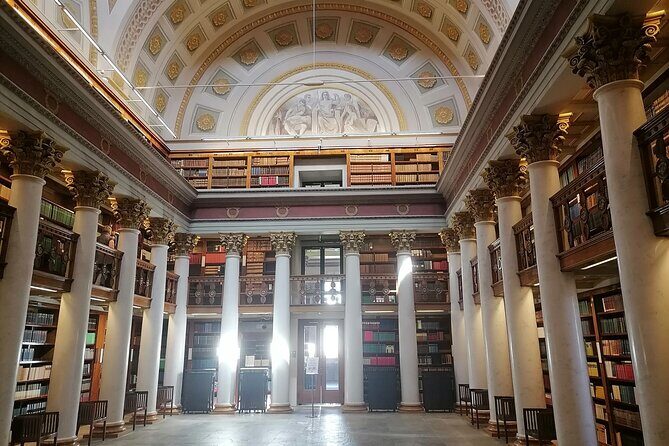
The National Library of Finland is one of the prettiest stops on the route, and it’s treated like more than a photo background. You’ll see it as a cultural landmark tied to Finnish priorities: learning, public knowledge, and shared intellectual space.
Admission is listed as free, and this stop is about 15 minutes. Big caution if you’re planning a weekend visit: the National Library is closed on Saturday and Sunday, so on those days you’ll want the tour date that fits your schedule.
This is also the first of the “slow down” moments. It’s where the tour starts to feel like a story about how people build spaces for thinking and reading.





Presidential Palace and Parliament: democracy you can point at

After the library and its ideas about public life, the tour turns to political identity with the Presidential Palace. It’s described as a symbol of Finnish democracy and political history, located on Pohjoisesplanadi Street.
The stop is brief—around 5 minutes—but it matters because the guide connects “democracy” to place. You’re seeing the physical markers of governance, and you’re hearing how Finland’s political culture gets shaped in everyday city space.
The tour also includes a moment for the Parliament House, described as the heart of Finnish democracy where debates take place. Even if you’re not a politics person, I like these stops because they make government feel less abstract. It becomes visible and walkable, not something you only read about.
Uspenski Cathedral: Russian Orthodox architecture in Helsinki

Uspenski Cathedral is next, completed in 1868 and noted as the biggest and most known Russian Orthodox church in Helsinki. This stop gives you contrast: Finland isn’t one-note culturally, and architecture shows those layers clearly.
Admission is not included here either, and the stop is short—about 5 minutes. That’s still enough time to get oriented and to understand what you’re looking at, especially if the guide points out key architectural cues.
If you care about how history moves across borders, this is a strong stop. It helps explain why Helsinki looks the way it does, even when you’re expecting one national style.
Kauppatori and Old Market Hall: shopping as local ritual
Then the tour slides into the everyday side of Helsinki at Kauppatori. You’ll spend about 10 minutes learning the fascinating history of the area and how the space supports city life.
A highlight right after that is Old Market Hall (Vanha Kauppahalli). This covered market opened in 1889, near the South Harbor, and it’s one of the oldest market halls in Finland. Admission is listed as free, and you’ll get around 10 minutes here.
What you can expect inside:
- Fresh local produce
- Finnish specialties like smoked salmon and reindeer meat
- Traditional pastries
- Handicrafts and souvenirs
One important weekend detail: the Old Market Hall is closed on Sundays. If your visit includes a Sunday, the tour date matters for this portion.
Even if you don’t plan to buy anything, this stop is valuable. Markets show how a city feeds itself, and they reflect local habits you can’t fully capture from museums.
Esplanadi and city rhythm: a boulevard for all seasons
Next you’ll walk along Esplanadi, described as Helsinki’s main boulevard and the heart of city life year-round. It’s a change of pace from cathedrals and palaces. This is where you feel how the city actually moves.
You’ll also touch on community and culture in a less formal way. The route includes exploring the Swedish-speaking community’s art scenes, plus time connected to modern art at Kiasma, Finland’s premier modern art museum.
Even though museum time isn’t spelled out in minutes here, the point is orientation: understanding Helsinki’s cultural balance between established institutions and contemporary voices.
Lasipalatsi Glass Palace and Finnish music in architecture
The walk brings you to Lasipalatsi (Glass Palace), an architectural standout with distinctive glass facades and innovative design. You’ll get about 10 minutes around it, focusing on why it matters visually and socially.
This building is also described as a home for renowned Finnish orchestras, concerts, and performances. That connection is the sort of thing I love in a city tour: you stop seeing architecture as decoration and start seeing it as a platform for community.
From here, you’re also moving toward the civic center feel again, building momentum into the final stretches.
Central Railway Station to Oodi: Helsinki’s monuments and everyday pride
Helsinki Central Railway Station comes next. It’s framed as a beautiful landmark guarded by four massive statues, and it’s a quick 10-minute stop with lots of photo opportunities.
From the station, the tour includes time to experience Finnish art at Ateneum, described as Finland’s national gallery. That’s another “culture without rushing” moment, tying the walk back to why people build public institutions in the first place.
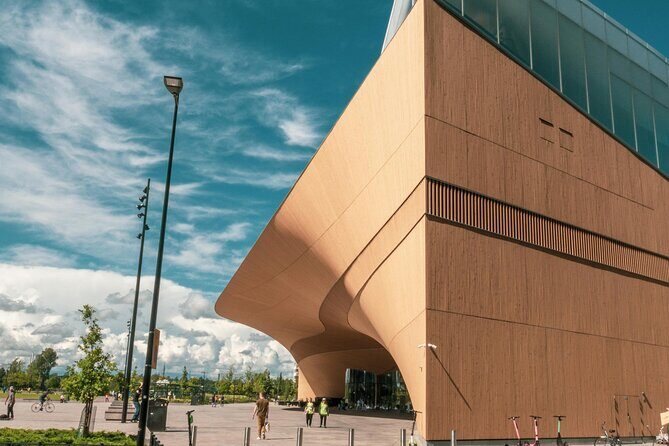
Then comes the real standout: Oodi Library. It’s treated as the highlight of the tour, and the guide’s message is simple—Oodi will mess with your idea of what a library can be. This is the kind of stop that makes the tour title make sense, even without a lecture feeling. You can see civic values in the way public space is designed.
It’s listed as about 20 minutes, admission-free, and it’s an ending that feels optimistic. You finish in a place that represents the city’s approach to shared space: practical, welcoming, and built for real use.
Value and logistics: what you’re really paying for
At $57.67 per person for about 3 hours, you’re paying for a local guide and a structured, paced walk through major sights and public institutions. The guide time is the core value; the included stops make the route feel “complete” without you needing to stitch together tickets and transport.
Most stops are listed with free admission, which helps keep the overall cost from ballooning. The two spots that may add separate admission costs are Helsinki Cathedral and Uspenski Cathedral, since both are listed as not included.
One more practical point: this is a good-weather style experience. If weather is poor, the tour can be adjusted. On chilly or rainy days, wear shoes you trust and bring layers, because you’ll be on foot for the whole session.
Finally, the tour is booked about 35 days in advance on average, so if your schedule is tight, you’ll do yourself a favor by reserving earlier rather than waiting for the last minute.
Who this tour fits best
This is a great choice if you like city tours that explain how society works. If you want simple sightseeing, you’ll still get the big landmarks. But you’ll enjoy it most if you care about how institutions and public spaces shape daily life.
It’s also a good fit for:
- First-time visitors who want a city core orientation
- People who enjoy architecture paired with context
- Anyone who gets excited by libraries, markets, and public buildings
If you’re traveling with limited time and you want to hit “important” places without hopping museums all day, this format hits a sweet spot.
Should you book this sociologist-led Helsinki walking tour?
I’d book it if you want Helsinki explained in plain language and you like walking through public spaces with a guide who can connect buildings to culture. The small-group setup and the focus on libraries and democracy make it feel more like learning the city than checking boxes.
Skip it—or at least reconsider your date—if your weekend schedule depends on the National Library (closed Saturday/Sunday) or the Old Market Hall (closed Sundays), since those parts are specifically time-sensitive.
If you’re open to mixing cathedrals, markets, and civic buildings into one coherent story, this tour is one of the best ways to understand Helsinki beyond postcards.
FAQ
How long is the Helsinki Walking Tour with a Sociologist?
The tour lasts about 3 hours.
What is the meeting point and the ending point?
You start at Kluuvikatu 3, 00100 Helsinki, Finland, and the tour ends at Oodi Library, Töölönlahdenkatu 4, 00100 Helsinki, Finland.
Is the tour in English?
Yes, the tour is offered in English.
How many people are in the group?
The tour has a maximum of 6 travelers.
What’s included in the price?
The included items are a 3-hour local guide and a mobile ticket.
Is food or transportation included?
No. Food and drinks, transportation, and tip or gratuity are not included.
Are admissions included for all stops?
Not always. Helsinki Cathedral and Uspenski Cathedral list admission as not included. Other stops on the route are listed as free.
Are any stops closed on weekends?
Yes. The National Library of Finland is closed on Saturday and Sunday. The Old Market Hall is closed on Sundays.
Can I get a full refund if I cancel?
Free cancellation is available, and you can cancel up to 24 hours in advance for a full refund.